Why Choose Oracle Cloud Applications?
All across the world, businesses are waking up to the benefits of moving their operations to the cloud. For businesses, the days of upgrading their unique on-premises infrastructure and running separate apps may be over. Oracle Cloud Applications is one example of cloud-based, corporate software that may help businesses modernize their operations to keep up with the rapid pace of change. Business demands are constantly evolving, and highly customized on-premises solutions simply can’t keep up. Oracle Cloud Applications give businesses simple access to cutting-edge tools. Possible Gains from Migrating to Oracle’s Cloud-Based Software Oracle Cloud Applications, because of their modern architecture and integration with the most recent advancements in IT, provide several advantages for businesses over their more antiquated predecessors. Reduce expenditures by using Oracle Cloud Applications to manage your software, servers, and other IT resources. The top ten benefits of using Oracle’s cloud platform Here are the ultimate ten justifications for going with Oracle Cloud. 1. Expansion of Oracle’s Cloud Infrastructure The development of Oracle Cloud in recent years has been remarkable. In 2019, its market was valued at $321 billion; by 2026, analysts expect that number to have increased to $1 trillion. Oracle Cloud is a strong competitor to industry leaders Amazon Web Services (AWS) and Microsoft Azure. NASDAQ data indicates that Oracle’s success may be attributed partly to the number of businesses switching to the Oracle Cloud. Cloud-based software accounts for the bulk of Oracle’s income. This is why Oracle Cloud is the best option among other cloud services. 2. Analyzing the Global Reach of Oracle’s Cloud Infrastructure There are now 30 cloud locations where users may use Oracle Cloud, making it a truly worldwide service. More regions and availability zones are being built quickly to accommodate requirements related to data sovereignty. Oracle Cloud also provides hybrid cloud features, such as the Cloud@Customer dedicated cloud region. By doing so, users may access the entire Oracle Cloud Services suite without leaving their premises. Additionally, a strategic alliance between Oracle Cloud and Microsoft Azure facilitates the deployment of applications across both clouds. 3. Sectional Design One of the main reasons to go with Oracle Cloud is because of the partitioning capabilities. The grouping of similar resources for use in isolating and restricting access to them is housed in “compartments.” To do this, a global logical namespace with strict restrictions is provided inside a folder or file. These regulations offer the correct access to consumers and businesses for optimal administration and resource management. 4. Digital Simulation Oracle Cloud is the only cloud service that offers an accurate Oracle database on Exadata and Rack, which can handle millions of transactions per second. Users will have near-seamless availability of the apps. It assures databases that can grow to hundreds of terabytes have high availability. 5. OCI’s Computing Services DevOps tools, monitoring, streaming, and services like Terraform for managing Infrastructure as Code are just some of the cloud-native services that Oracle has developed. It also offers tools like a registry for controlling Docker containers. Use Kubernetes to handle your container clusters’ management needs. In addition to providing dedicated network access (including fast connection), the edge also offers services such as global DNS and web application firewalls. All of these features contribute to an easy-to-use setting for creating applications. 6. The Capabilities for Optimal Performance Oracle’s IaaS has unmatched functionality and a feature set. It offers a second-generation platform with bare-metal services and remote direct memory access (RDMA) for technical computing clusters. These characteristics ensure that users are kept separate and that the system behaves as expected. 7. Full Backing for Making Apps Oracle is doing quite well in this dynamic setting. This platform provides an open, comprehensive option for developers looking to create, launch, and manage cutting-edge APIs and mobile-first apps on a budget. It also helps with cloud-native low-code projects and containers. It also provides a DevOps environment, which simplifies using SaaS’s continuous integration (CI), continuous delivery, deep diagnostics for Java applications, and optimized integration features. Therefore, there is a compelling reason to go with Oracle Cloud. 8. Interface that’s simple to navigate Oracle’s cloud service, Oracle Cloud, features a user interface that’s a breeze to use. Everything is neatly lined up and in its proper location for maximum use. Oracle Cloud allows users to test their services risk-free for 30 days with free credit. With eight accessible instances worldwide, you can access up to 5 TB of storage space. 9. Oracle Cloud Fuels Small and Medium-Sized Business Expansion Oracle Cloud were created so that small and medium-sized companies (SMBs) may also profit from using it (Small and Medium businesses). Small and medium-sized companies see a significant increase in application utilization alongside their rapid expansion. As a result, Oracle Cloud is compatible with older and more cutting-edge development and critical workload management solutions. 10. Oracle’s Cloud Is More Effective Than Amazon’s The best alternative for running Oracle Database for essential corporate applications is Oracle Cloud due to its optimum performance and extremely low pricing. The Oracle Autonomous Cloud, Oracle ATP, and Oracle ADW are unavailable on Amazon Web Services. With Amazon Aurora, consumers are locked into using just AWS, but with Oracle Database, users may choose from various providers. Conclusion: Oracle Cloud is one of the most promising new cloud platforms. It offers numerous advantages over competing cloud services. Oracle Cloud has the resources and potential to keep the industry evolving and expanding. It’s constantly adding new functionality and services to its toolkit. As a result, Oracle Cloud is an excellent option, particularly if you require outstanding performance at a reasonable price. Providing a large quantity of information in a manner that can be easily understood and used is a significant difficulty in the retail industry. The importance of this has only grown with the rise of social media, omnichannel shopping, and the drive to expand into new forms and nations. Because of their role as the hub around which all other data revolves, merchandising systems provide businesses with a clear
Unleash the true potential of Oracle Retail Merchandising with Trangile
Having the proper quantity of information readily accessible in a useful and consumable style is one of retail’s greatest issues. This is more crucial than ever in light of the rise of social media, omnichannel shopping, and the drive to grow into new forms and regions. Keeping tabs on purchase orders, keeping an eye on deal revenue, adjusting replenishment settings based on consumer demand, comprehending product purchasing patterns, and compiling all of this data into stock ledger reports are essential for any retailer. Merchandising solutions act as the hub around which all other data revolves, giving businesses a clear and concise picture of how their retail operations are doing. The solution is theoretically simple: allow retailers to engage in an end-to-end process of supporting their customer’s shopping experience in any channel. From pricing to availability to returns, every element of the retail experience must be developed and delivered with convenience in mind. Any barriers can quickly become insurmountable in a world where consumers are only a click away from a competitor. To provide this experience, retailers must have unified product, price, and inventory management, plus a single source of transaction information across the business, culminating in the delivery of seamless supply chain execution across channels, brands, and countries. Oracle Retail Merchandise Operations Management (MOM) is one such solution specifically designed for retail. It is the central source of information and helps retailers with a simplified and accurate view across retail organizations resulting in an improved retail consumer experience. Cloud Services for Retail and eCommerce from ORACLE: Oracle’s Retail Merchandising Cloud Services are SaaS tools that help retailers make faster, more informed business decisions. These tools include role-based dashboards that provide important data about purchases, stock levels, costs, and other metrics. The solution allows merchandising experts to spend less on administrative work and more on strategic business objectives by leveraging Oracle’s contemporary exception-based retailing approach to detect circumstances that demand attention. Key benefits of ORACLE Retail Merchandising cloud services: ORACLE retail offers full-cycle merchandising services which form the backbone of every successful retail business. Oracle’s full range of retail merchandising services comprises: Key Features of Oracle Retail MOM : Trangile is the leading and one of the preferred global partners in the market for Implementing the Oracle Retail MOM solutions. The integrated suite of applications will help you know the real-time inventory across the company, create and maintain Masters-Item, supplier, execute pricing decisions, promotions management, and Deals management while also managing the inventory procurement transactions to invoice matching. Reasons why clients choose Trangile for Oracle Retail MOM implementation : Trangile’s Oracle Centre of Excellence comprises best practices, processes, tools and expert manpower for all focused areas offered through our specialized services offering. Trangile Oracle Retail Service Offerings: Our highly skilled resources with many years of experience and training can help you accelerate your implementations and adapt to new systems. Our resources are cross-trained to provide expertise in On-Premise implementation or on Cloud. Are you ready to take advantage of Oracle Retail’s best aspects? Get started with Trangile right now. Speak to us to understand how you can quickly implement high-value implementations aligned to business priorities with minimal customizations. We’re here to help. Get in Touch with Us
Oracle Retail Cloud Services – How Does it Benefit Retailers?
Introduction: Retail is one of the many industries that has made a significant move to the cloud. According to the International Data Corporation (IDC), public cloud service spending is predicted to rise by 19.4 per cent each year worldwide (CAGR). Clearly, cloud computing has played a critical role in company growth. For this reason, Oracle has now announced Oracle Retail version 16, which includes 33 cloud-enabled retail services, to help merchants stay up to today’s corporate standards and customer expectations. Oracle Retail Cloud v16 has been developed to let retailers adopt cloud technology at their own speed and deliver a uniform customer experience across both online and brick and mortar locations. For peak season traffic, merchants may save expenses while enhancing reliability, uptime, and time-to-market. Retailers have realised the need of creating businesses that allow customers to shop whenever and wherever they choose. Merchants may now benefit from enhanced productivity and the flexibility to quickly adjust to current retailing trends thanks to cloud computing. 37 per cent of small and medium-sized enterprises have adopted cloud computing services, according to Business 2 Community research. This is achievable thanks to Oracle Retail v16’s comprehensive retail solutions. Among the various solutions to these problems are product planning, inventory management, customer interaction, Omni-channel features, flexible websites, consumer intelligence collecting, and even the creation of crucial reports. Here are the reasons how Oracle Benefit Retailers: Oracle Cloud vs AWS If you’re looking to run mission-critical applications on Oracle Database, then Oracle Cloud is the best option. It provides exceptional performance at the lowest price. Amazon Aurora does not provide Oracle RAC, Oracle Autonomous Data Warehouse, or Oracle Autonomous Transaction Processing, while Oracle Database allows customers to pick from a variety of vendors. Maximized return on investment For the first time, Oracle Cloud Infrastructure is the most cost-effective option today. With fewer compute servers and block storage volumes, Oracle Cloud Infrastructure can improve workload performance. Its non-blocking architecture reduces latency; it also minimizes the risk of other network users affecting client environments and is supported by the industry’s most comprehensive, financially guaranteed, end-to-end SLAs in the cloud computing business. Get all the help you need to design an app For a fraction of the cost of conventional software, you can create API- and mobile-first cloud apps using an open, standards-based Oracle application development platform. Low-code development is supported by Oracle in containers and the cloud. For continuous integration (CI) and continuous delivery (CD), it offers a comprehensive DevOps environment, with deep diagnostics for Java applications, as well as quick integration with SaaS and on-premises services. Designed for Oracle workloads In order to facilitate the migration and management of Oracle’s database and business application portfolio, Oracle Cloud Infrastructure provides a variety of unique features and capabilities. As a consequence, the costs and time associated with moving Oracle applications to the cloud are reduced. Oracle places a high priority on providing our customers with the most up-to-date hardware and software. A defence that is well-rounded in its approach Security is a top concern for Oracle Cloud Infrastructure. As part of Oracle’s secure by design features, the company helps protect clients’ data, monitors internal dangers, and responds swiftly and automatically to these threats. Data and communications are shielded from other users because of Oracle’s design. In addition, keeping your administrative PCs isolated from your software’s source code, data, and resources helps keep your cloud data safe from hacking. Granular customer isolation in Oracle Cloud minimises the attack surface. Attacks are prevented from accessing the network thanks to integrated firewalls, DDoS protection, and encryption. Adaptive authentication may be used to automatically add further verification if user behaviour indicates greater levels of hazard after establishing identity at the new border. Oracle is a key participant in the industry because of its vast variety of cloud and on-premise security services. Reasons To Consider Merchandising Through The Cloud(In Short): ● There are various inherent risks when executing a big on-premises project, such as cost overruns caused by schedule delays or unanticipated IT difficulties. ● Let go of the decades-long cycle of renovations that have disrupted enterprises by ripping and replacing. ● An organisation may cultivate a culture of innovation and growth by making new features readily available. ● Retail teams are finding it almost impossible to keep up with the ever-increasing security requirements. As a result of moving to cloud-based services, customers get access to more resources while also decreasing their exposure to security risks. ● The best-of-the-best cloud applications include current best practices for corporate teams right in their code. There’s no need to fiddle with solutions that already have a lot going for them. ● Nowadays, user interfaces look and act more like browsers and programmes that people are already familiar with in their daily lives. As a result, new employees’ on-the-job learning curve is reduced and productivity is increased. ● It is easier and more cost-effective to get results following a purchase, the launch of a new brand, or the expansion of a company’s market reach using cloud technologies. Conclusion: It is possible for top management to support a change in merchandising systems, which is the initial step in many shops’ next wave of growth. Because more time is available for other sections of the firm to benefit from replacing ageing legacy systems, the sooner they are replaced, the better. Merchandising’s capacity to teach and support new initiatives quickly and in the long term benefits marketing, logistics, mobile, commerce, retail, planning, and other operations. From the beginning, companies have access to cutting-edge technologies that are simple to use and already linked with omnichannel operations and customer journeys. Are you ready to take advantage of Oracle Retail’s best aspects? Get started with Trangile right now. We’re here to help. Get in Touch with Us
Trangile arrived in London now!!!!!!
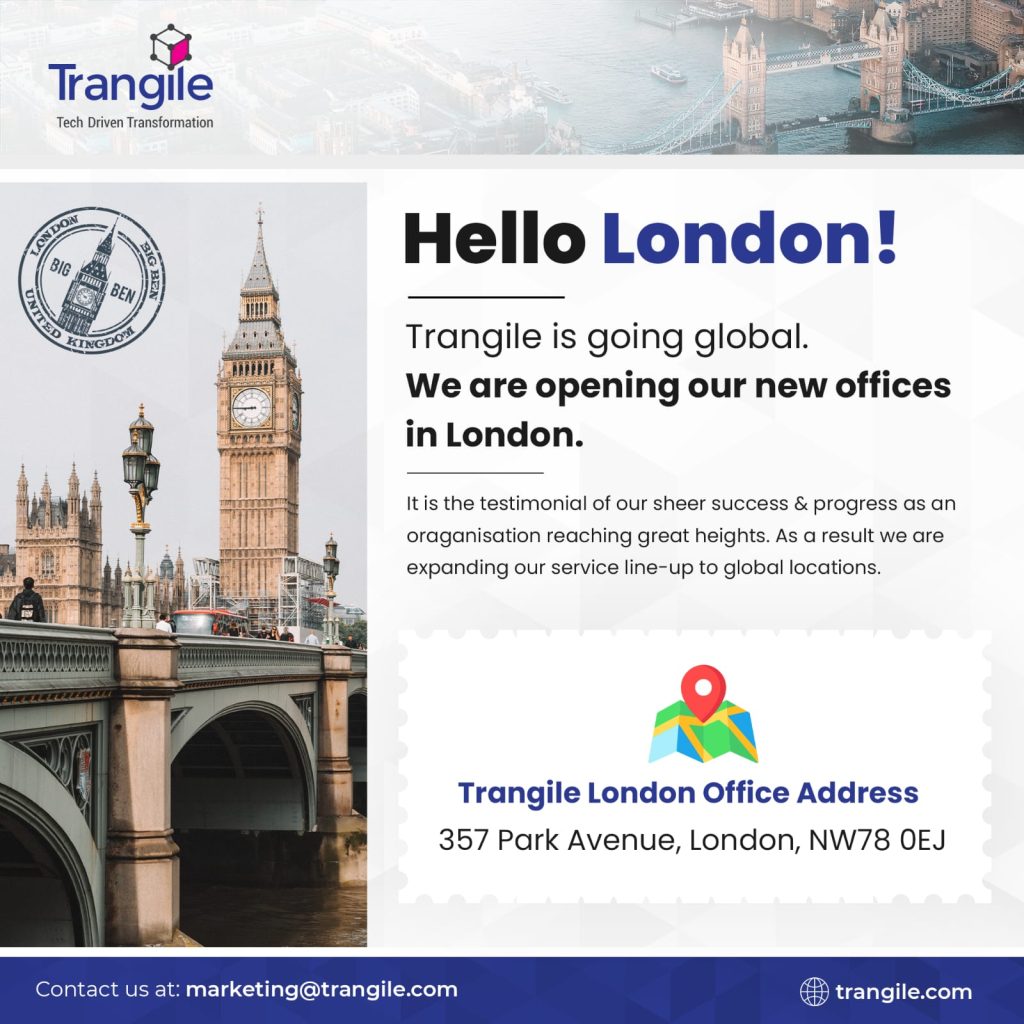
We at Trangile have seen overwhelming growth & increase in project activities over the last few years, so this organically led to the opening of our new office in London, UK. We want to thank all our clients for making this possible! In the end, everything we do, we do to serve them better and provide them with the best results possible. And the new office is proving to be effective in this right from the start! It will enable us to meet the growing needs of our UK-based clients even more efficiently, while still providing them with the highest level of service. And all these achievements and growth were never possible without our awesome team members. Your contributions to this project have been invaluable. Thank you for all your hard work & support. Cheers to our new office!
The benefits of implementing Oracle Retail for your business
Oracle Retail is a comprehensive suite of software solutions designed to help businesses streamline their retail operations, increase efficiency, and improve the customer experience. What advantages Oracle Retail can provide for your company may be on your mind if you’re thinking about implementing it. In this blog post, we’ll explore the advantages of implementing Oracle Retail and how it can help take your business to the next level Streamlined Operations One of the most significant benefits of implementing Oracle Retail is that it can help streamline your business operations. With Oracle Retail, you can consolidate your inventory and sales data into a single platform, making it easier to manage your supply chain, optimize your inventory levels, and improve your forecasting accuracy. This can improve your profitability, cut down on waste and inefficiencies, and guarantee that you always have the right products on hand. Improved Customer Experience You can enhance customer satisfaction in your stores by utilizing Oracle Retail. With features like real-time inventory visibility and mobile point-of-sale systems, you can offer your customers a more personalized shopping experience that meets their needs and preferences. Additionally, with Oracle Retail, you can track customer buying patterns and use this data to tailor your marketing and promotions, improving customer retention and loyalty. Enhanced Analytics and Reporting One of the key benefits of Oracle Retail is its robust analytics and reporting capabilities. With Oracle Retail, you can generate detailed reports on sales trends, customer behavior, inventory levels, and other key metrics, giving you the insights you need to make informed business decisions. Additionally, with Oracle Retail’s predictive analytics tools, you can anticipate future trends and adjust your strategies accordingly, helping you stay ahead of the competition. Better Inventory Management Effective inventory management is essential to the success of any retail business, and Oracle Retail can help you optimize your inventory levels to reduce waste and improve profitability. With Oracle Retail, you can track inventory levels in real-time, automate your ordering and replenishment processes, and monitor sales trends to ensure that you always have the right products in stock. This can help you reduce your inventory carrying costs and improve your bottom line. Increased Efficiency Many of your business processes can be automated with Oracle Retail, resulting in less manual work and greater productivity. With Oracle Retail, you can automate tasks like inventory management, ordering and replenishment, and sales forecasting, freeing up your staff to focus on other tasks. This can help you reduce labor costs, improve productivity, and ensure that your business operates at peak efficiency. Improved Scalability As your business grows, it’s essential to have a retail management solution that can grow with you. Oracle Retail is designed to be scalable, so it can accommodate your business’s changing needs as you expand. With Oracle Retail, you can add new stores, warehouses, and distribution centres to your network seamlessly, ensuring that your business remains efficient and profitable as it grows. Integration with Other Systems Oracle Retail can integrate seamlessly with other business systems, such as ERP and eCommerce platforms, enabling you to streamline your operations and improve your overall efficiency. You can work more productively and efficiently with Oracle Retail because it eliminates the need for manual data entry, reduces errors, and enhances departmental communication. Conclusion Implementing Oracle Retail can provide numerous benefits for your business, including streamlined operations, an improved customer experience, enhanced analytics and reporting, better inventory management, increased efficiency, improved scalability, enhanced security, and integration with other systems. By leveraging the power of Oracle Retail, you can optimize your retail operations, reduce costs, and drive growth and profitability for your business. Working with a reputable partner who can assist you with Oracle Retail implementation, training, and support is essential if you’re thinking about doing so. A certified Oracle Retail partner can help you adapt the software to your specific business needs so you can get the most out of your investment. In conclusion, Oracle Retail is a powerful retail management solution that can help businesses of all sizes optimize their operations, improve their customer experience, and drive growth and profitability. If you want to expand your retail company, implementing Oracle Retail might be the solution you’ve been looking for. Are you ready to take advantage of Oracle Retail’s best aspects? Get started with Trangile right now.We’re here to help. Get in Touch with Us
How effective implementation of cloud can increase business revenue?
The number of businesses using cloud computing has skyrocketed in recent years. The shift from installing and running software on an organization’s servers to having it hosted by a third party in the cloud has been spurred by the many advantages seen by businesses. By the end of 2018, most businesses will likely use at least one cloud service as cloud computing becomes the standard in the corporate world. Cloud computing allows smaller IT enterprises to access the same cutting-edge tools as their larger counterparts. The use of cloud computing has several positive effects on a company’s output, efficiency, and cash flow. This article discusses the effects of cloud computing on small and medium-sized enterprises and the top advantages it provides to businesses. Reasons Why Cloud Can Increase Business Revenue Here are the nine most compelling reasons businesses should use cloud computing in 2021. Increase the speed of your digital transformation with our top-notch cloud migration and development services : 1. Capacity to Grow Scalability is built into the cloud, one of its main selling points. For instance, the ability to swiftly and painlessly grow an IT system may have far-reaching effects on a company. Historically, businesses were limited by their hardware arrangement’s size and processing power, making it impossible to scale an environment on demand. Due to the cloud, this restriction is now obsolete. The cloud has completely altered how organizations handle their IT infrastructure. 2. Originality A company’s success may be traced back to its ability to innovate and adapt. Using outdated technology might hamper an organization’s capacity for innovation and scale deployment. In the area of online applications, battling back-end performance concerns may be a daunting challenge. The cloud may boost efficiency, reduce expenses, and expand flexibility when used as a foundation for new ideas. For instance, businesses use cloud computing to accelerate innovation in the Internet of Things (IoT) product development. The whole digital ecosystem, including the Internet of Things (IoT), has benefited from cloud computing’s ability to spur innovation, creativity, and the introduction of game-changing new products. 3. It Saves Money One of the main benefits of cloud computing is the cost savings it may provide to a company. The appropriate way to tackle the question of cost isn’t to calculate how much money you may save by moving to the cloud, even if this is a valid concern. Instead, compare the amount your company is now paying on IT services to the amount it will spend after it moves everything to the cloud. These differences make it difficult to estimate how much money will be spent on a cloud service. The use of a cloud partner for a rough calculation is often suggested. 4. Superior DevOps DevOps improves deployment frequency and quality. This is done via a flexible communication mechanism that promotes teamwork throughout the development cycle.DevOps helps companies quickly add new features without losing stability. A firm that doesn’t use cloud computing with DevOps misses out on the potential to speed up product development. Cloud computing provides for constant feature rollout (without compromising the reliability of the underlying applications). 5. Better compliance and security Large cloud service providers have strict data security, compliance, and protection standards.Many firm leaders exploring cloud computing are concerned about moving essential apps (and possibly sensitive corporate or customer data) to the cloud. All big cloud service providers spend a lot of effort and money on security and regulatory/compliance requirements. Businesses in highly regulated industries, such as healthcare, government, pharmaceuticals, and the military, must follow industry-specific compliance laws to protect their apps and client data. Every leading organization in these (and neighboring) areas employs cloud services 6. Adaptability Many firms like cloud computing’s adaptability. Cloud infrastructure improves scalability and flexibility. Future-proofing adds to the cloud’s flexibility. Adapting to new trends is key to long-term success in the IT business. Company expansion used to be costly and time-consuming, requiring considerable investment in a single endeavor (that may or may not generate business growth). Modern technologies allow organizations to scale up or down in response to market shifts swiftly. Cloud computing’s scalability enables on-demand access. Cloud computing offers operational flexibility at lower prices (compared to more traditionally resource-intensive methods). 7. IT Management Simplified Executives and business owners frequently struggle to balance investing in R&D with managing and protecting their sophisticated IT infrastructure. When organizations go to the cloud, they no longer have to worry about internal IT security and administration, freeing up resources to develop other areas. If a firm migrates to the cloud, it will have more time and money to spend on expansion, customer service, and innovative growth tactics 8. Provide a Wide Range of Services The four primary deployment types are public, private, hybrid, and community clouds. When developing a cloud strategy, it is important to consider the benefits and drawbacks of the various cloud deployment types.Rather than committing to a single cloud service provider, the increasing trend in the market is for most businesses to choose a hybrid model. 9. Constant Development in the Market Although the cloud’s beginnings may be traced back to the 1960s, it wasn’t until the previous decade that it saw broad acceptance among corporations. Cloud computing has grown rapidly over the last decade, and its popularity is expected to increase (especially with the IoT industry set to experience a massive growth surge in the coming years). Increased use of AI and ML techniques and the maturation of edge computing (particularly in the cloud computing ecosystem) bodes well for the sector’s future. In the coming decade, businesses in almost every sector will feel the effects of the explosion in computer power and end-user capabilities. Cooperation With Third-Party Cloud Providers Organizations can grow, keep their options open, and concentrate their attention is needed most: on core business functions, thanks to cloud computing. Working with a cloud partner is one of the greatest ways to maximize the benefits of cloud computing for your company. If your company needs more time and energy to concentrate
Empower Future Of Retail Businesses With Oracle

The retail industry is always evolving. Due to technological changes, demanding customers, and changing buying habits, major retailers are realising that the market has become extremely competitive. It is currently difficult for retailers that are unable to adapt and respond to these difficulties to grow and remain in the sector. As the largest business software vendor globally, Oracle offers a huge library of products, including database services, platforms, software, hardware and more. Why is Oracle Retail recognised as the greatest ERP system for the retail industry, and what solutions does it provide? Oracle is consistently ranked highly in their retail offerings and is the best in a number of categories. One of the major reasons that people get confused as to what exactly Oracle Retail does is because of the sheer number of offerings that come under its umbrella. These products are split up into a series of categories, each fulfilling a different purpose – merchandising, insights and science, omnichannel, planning and optimisation, supply chain and hardware. Oracle Retail provides some of the best-in-class products for the Retail Industry and our consultants with their in-Depth knowledge and experience will implement and deliver successful solutions in Merchandising, Store solutions, Warehouse management, Omnichannel, Planning and Analytics listed below : How Oracle Xstore POS changing the Retail Dynamics Oracle Xstore is a comprehensive and adaptable point-of-sale system. The system provides solutions that are tailored to the needs of executives and sales personnel in central and store operations. It allows central management to organise all stores, evaluate performance and provide reporting for shops and personnel, and assign tasks to individual stores and personnel. Oracle Retail Xstore Point of Service is an embedded point-of-sale solution that efficiently helps in managing processes of today’s omnichannel retail landscape through user-friendly process flows and customer-friendly efficiency. It includes store management features like shift management and follow-up, as well as employee performance reporting. It also delivers businesses the tools they need to improve sales performance, build relationships with clients, maintain sales and protect brand recognition, and engage with clients. The Oracle Retail solution suite is fully compatible with Xstore. Each module of the solutions family is immediately usable after installation. It can be integrated into an organization’s existing infrastructure or other third-party systems. Improving the operator’s existing infrastructure’s skills immediately. Several retailers intend to accelerate Oracle Retail Xstore POS upgrades in order to take advantage of the built-in omnichannel and mobility capabilities provided by the most recent version of this leading POS platform. Key Benefits Of Oracle Retail Xstore POS Robust Functionality Oracle Retail Xstore POS combines both front-end and back-end store management functionality. This includes basic sale/return transactions of merchandise, payment tenders to inventory, visibility across the enterprise, customer search, pricing history, electronic journals, centralized application management tools, and much more. Single Source of Data Oracle Retail Xstore is not just a Point-of-Sale system, it provides the retailer with complete “Point-of-Service” functionality. Full insights on customer data, purchase history, the loyalty program, as well as the ability to receive or place new orders to up-sell and cross-sell products, from any store or sales channel across the enterprise are all included in this package. Mobility Oracle Retail Xstore supports the most popular mobile devices such as iOS, Android and Windows-based tablets or phones. Store associates can use mobile devices, to either perform a sale, look up a customer, perform a product search, locate a goods receipt, and many other operations from anywhere in the store. This results in improved customer service and greater operational efficiency. Multi-country Operations Oracle Retail Xstore is built to manage retail operations seamlessly across different countries, with different currencies, tax rates, and languages. This means that the customer is presented with a familiar brand experience and the management gets a single consolidated view of their operational status. Leverage on Integration With Oracle Ecommerce, the integration of loyalty management, order management, and order fulfilment applications will shorten implementation times and lower their cost. By using this set of products, retailers can provide the customer with a seamless omnichannel experience. Our Oracle retail consulting and expertise spans across the length and breadth of the retail industry Trangile provides end-to-end retail transformation services to help shoppers have a more modern shopping experience. Our Oracle retail consulting and expertise extends across the entire retail industry. Trangile has always assisted retailers in business expansion and revenue growth through our offerings ranging from customer-centric solutions to productivity-enhancing applications. Let Trangile help you move forward on your Point-of-Service journey. Regardless of your priorities or current business challenges, Trangile has the skillset and expertise to help you move forward quickly. Get in touch with us.
Cloud Migration: Strategies, Benefits & Planning
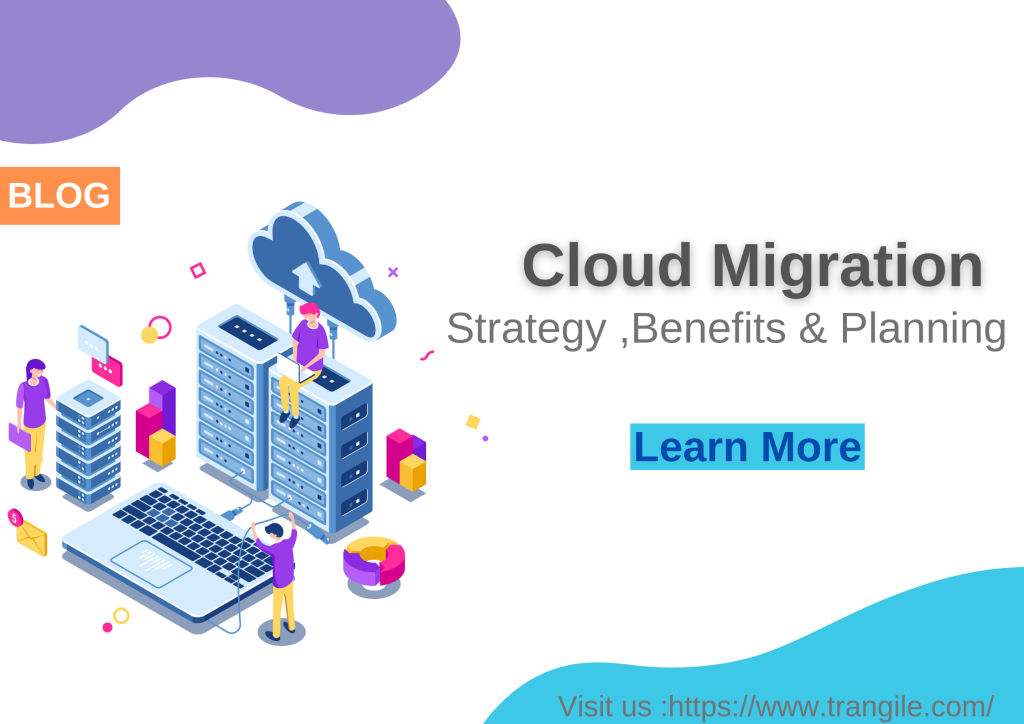
The global adoption of cloud technology has escalated due to the Covid-19 coronavirus pandemic, and this trend appears to be ready to continue for the future. Businesses must migrate to the cloud to ensure company continuity due to the growing remote work culture, underlining the need to plan and implement cloud migration. However, due to the complexity of data migration processes, enterprises are overwhelmed when implementing cloud services. Let’s know more details about it: What Cloud Migration means? The term “cloud migration” refers to moving digital processes from on-site to a cloud platform. Data, techniques, and applications are all moved to third-party servers when you migrate to the cloud. When a business decides to move to cloud services, it usually means switching from on-premises or legacy infrastructure to cloud-based ones. It is the process of migrating tools and data from on-premises data centres or legacy infrastructure to the cloud. Why are Businesses migrating to the cloud? According to the latest report of Gartner, Worldwide end-user spending on public cloud services forecast to grow 23.1% in 2021 to total $332.3 billion. Many businesses are adopting cloud migration because it provides them with a significantly more flexible and dependable IT infrastructure planned to streamline processes. Your business may need to prepare for the shift before moving to the cloud completely — these procedures are essential to guarantee everything goes smoothly. To begin, we must evaluate our legacy software if it is compatible with the cloud. Outdated software may not be compatible with cloud migration, posing difficulties. The problems aren’t insurmountable, but they necessitate a discussion about security, protection, and multiple solutions. Strategies for Cloud Migration: When it comes to optimising operations, there are 5 R’s basic migration plan techniques that organisations can opt The “5 Rs” are five cloud migration strategies described by Gartner. Organisations considering a cloud migration should think about which migration approach best fits their needs. Rehost- Also known as “Lift & Shift.” Rehosting is also known as “lift and shift” since it is the most straightforward approach to move your on-premises IT infrastructure to the cloud with the least amount of disruption to your workloads and ways of working. Your existing data and apps are re-deployed on the cloud server. This is simple to implement and is hence appropriate for firms who are unfamiliar with cloud systems. Replatform- Also known as “Lift & Reshaping.” This strategy has few optimisations before moving into the cloud, such as moving from hosted to managed services and from commercial to open-source software. It requires a small amount of Up Versioning to move applications as it is. Refactor (ReArchitect) It improves the performance of an on-premises application to support cloud architecture. Usually, it is at the other end of the migration effort spectrum. Organisations that seek to change their applications and infrastructure from a monolithic to a service-oriented (or server-less) architecture may use that strategy to enhance agility or continuity in business and maximise the cost-effectiveness of the cloud. Retain (revisit/no movement) In some scenarios, the business may decide not to touch particular systems and applications and postpone migration later. In addition, the application is too crucial to be amended and needs to be analysed more closely. Retire The strategy involves openly phasing out of the application. It makes sense when this application no longer requires or offers redundant business features. While migrating a project to the cloud, you might discover redundant applications, and taking them down can save you money. The savings will improve the business case, focus your team’s limited attention on the things that people use. Key Benefits of Switching from On-Premise to the Cloud Cost-Effective This highly responsive system can help with cost savings as these other systems need to pay for as long as they are in place. Costly data centres and on-site servers will not have to be bought, maintained and eventually replaced. Improved Operational Efficiency The organisations have the opportunity to fit a range of enterprise systems and solutions with cloud-based services. This makes modernisation and interlinking existing applications and solutions easier for companies. Connectivity helps companies improve promotional efficiency and the productivity of employees. Enhanced Security Industries in various sectors have migrated data from local data centres to the cloud from corporations and customers. It helps in securing & managing data across all cloud platforms. Cloud hosting providers monitor and update their security features continuously, so data is as secure as possible. Increased Scalability & Flexibility It simplifies business and increases its speed, making the company profitable. When using cloud-based solutions, it is much easier to improve and maintain the performance of the business. Reduce the complexity of IT infrastructure Provide services and technology that help companies modernise IT processes and develop agile and efficient pipelines What is the process to plan Cloud Migration? We help your IT and app development teams stay abreast of cloud technologies, migration tools, and operational processes. Let’s know more about the process : Defining Strategy: Implementing cloud strategy and targets according to migration challenges, business objectives and process priorities Analysing Current Infrastructure scenario: Identifying and store your infrastructure in detail and evaluate your environment on-site Migration Plan We present a complete migration plan based on priorities for the task, time frames, key deliverables, resources, and budget. How Trangile Helps? Services we offer Trangile has helped a wide range of customers by providing friendly and time-saving cloud migration solutions. Here we have listed how we can help to restructure the process: Consulting : Maintenance Infra Service Collaboration Cybersecurity Engineering Are you ready to take advantage of the cloud’s best aspects? Get started with Trangile right now.We’re here to help. Get in Touch with Us
All you need to know about Cloud Computing and Cloud Storage
To what extent do cloud computing and cloud storage vary from one another? The short answer is that “cloud computing” refers to the execution of tasks, such as using software, through the internet and that “cloud storage” refers to the retention of information on remote servers for online access. In case you’re curious, we’re delving further to explain how cloud computing differs from cloud storage and the many scenarios in which both might be useful. One easy method to differentiate between cloud computing and cloud storage is to think of it this way: Computing in the cloud equals processing, and cloud storage equals data. When comparing cloud services, it’s important to distinguish between cloud computing and cloud storage. The term “Cloud” has become shorthand for various online services and resources that may benefit everyone. Cloud computing and cloud storage are two such choices. Each has value for companies when properly executed, but each cannot do so without the other. While cloud storage may exist independently of cloud computing, online processing is required to retrieve cloud-stored data through the internet. It’s the same with cloud computing; applications require a place to live, and cloud storage is an essential component. Let’s look at some real-world applications of cloud computing and cloud storage to grasp the connection between them better. Why Should You Use Cloud Storage? The term “cloud storage” refers to any remote data and file storage method, including backups. This solution’s primary advantage is that it safeguards data and makes it accessible in the event of a calamity, such as the destruction of a firm by fire. Data is not saved locally on workers’ devices but a remote server. Among the many advantages are: What’s Good About Cloud Computing To conduct a computational task or operate an application in the cloud, you need access to the internet. Therefore, moving a significant percentage of an organization’s IT needs to a cloud-based infrastructure has several advantages. Benefits of Cloud Computing: Moving Data Or Applications To The Cloud? Cloud migration refers to migrating data and processes to the cloud. An Adobe Cloud subscription provides access to both cloud-based software and storage (cloud storage). This is an example of the Software-as-a-Service paradigm, although there are various pathways to the cloud. Solutions for Moving to the Cloud For most office personnel, when we speak about cloud computing, we are talking about adopting solutions so you can perform your job from anywhere and save money. Your possibilities here include Software-as-a-Service, Desktop Virtualization, and application hosting. Google Docs is a SaaS that exemplifies the concept. Everything, including the app and data, is hosted by Google. Rather, think of it as an online version of Microsoft Word. Using a remote connection, you may access the program just as if it had been installed on your computer’s hard drive. Through the usage of a remote server, users’ whole desktop environments may be hosted virtually; all require an internet connection. It’s easy to see an extremely lengthy connection running from your display to the faraway place where it connects to your computer across stateliness. Desktop hosting works like this, providing a frictionless experience while being safe. With virtual desktop hosting, you may link all of your numerous clouds, from SaaS to application hosting. Options for Moving Data to the Cloud Consumers have the most incredible experience with public cloud storage. Cloud computing services such as AWS, Azure, GCP, and iCloud are included. Cloud services are used for various purposes, including data storage, hosting front- and back-office applications, and archiving SaaS native solutions. An outside company is responsible for the architecture, maintenance, and monitoring of your cloud-based data and applications with managed cloud hosting services. This is a safe way to store confidential company data like financial records or trade secrets. In addition, dedicated hosting allows enterprises to swiftly create a cloud solution for more mobility and tighter control of data and systems. Connections between internal data centers are still commonplace and may be established using technologies like remote desktops and virtual private networks. However, given the volume of data enterprises produce today, they are seldom the only storage a firm possesses. Organizations want a partner firm dedicated to cloud architecture to help them stay up. Your data might be gone forever if you don’t save a copy of it somewhere else. When is the use of hosted virtual desktops appropriate? The user’s whole desktop environment may be stored and run from a distant server with the help of virtual desktop technology. This hosting solution is administered in the cloud and combines cloud computing and storage advantages. Examples of what you may get by using a hosted virtual desktop service are: Virtual desktop hosting solutions should be able to provide access to a wide range of software. The Final Thoughts The distinction between cloud computing and cloud storage should be clear. Cloud storage is for storing data and running operations. They complement one another and are necessary in today’s fast-paced technological world. For enterprises and individuals, cloud use encompasses both storage and computing. Trangile has helped a wide range of customers by providing friendly and time-saving cloud solutions. Are you ready to take advantage of the cloud’s best aspects? Get started with Trangile right now.We’re here to help. Get in Touch with Us
How Supply Chain Technology Is Evolving ?
Customers today have higher expectations because of changes in how business is done. Since next-day and same-day delivery has become the norm, it has created a new kind of pressure on companies. Because of this rise in demand, the whole supply chain is quickly moving from a focus on functions to a network of data and operations that spans the world and is connected. There are many new and growing ways for businesses to change their supply networks to meet the needs of their customers. Artificial intelligence, blockchain, and automation are part of the digital supply chain. This network combines data and information from many sources to move products along the value chain. For many years, cutting costs was essential in supply chain management. Today, this goal is to make customers happy, efficient, and keep going. Ethical behaviour has a significant impact on strategic supply chain management decisions. So lowering costs is still a goal, but it won’t be successful. Delivery Automation : Due to rising demand, many companies cannot keep up with the pace of delivery automation. Merchants call “the last mile” the last stop a product must make on its way from the warehouse or transportation hub. It’s becoming a significant issue, particularly in urban areas where consumers expect quick and flexible delivery. Some forward-thinking companies are automating parts of their last-mile delivery systems to meet customer needs while keeping overhead costs low. Using a combination of regular shipping, self-driving vehicles, and even smaller drones, you could set up “last-mile distribution hubs” as close as six or nine miles from big cities. Because there are smaller and more specific hubs for the last mile of delivery, companies may find more ways to get these goods to their customers. Retailers may also benefit from self-driving cars and drones, making last-mile deliveries much cheaper and more accessible.